


Role
UX/UI Designer
Contributions
• UX Research
• Information Architecture
• Data Visualization
• Design System Foundation
• Visual Design
• Prototyping & Usability testing
Elior Group operates in 11 countries and serves over 3.2 million guests every day. As the business grew, its internal operations became increasingly difficult to manage.
Budget planning, CDPF validation, workforce management, reporting, and operational tracking relied on hundreds of Excel spreadsheets and disconnected internal tools. This fragmented ecosystem slowed collaboration, increased administrative overhead, and made it difficult to maintain a single source of truth.
I designed a centralized operational planning platform that unified these workflows into one role based system while preserving the complexity required by the business.
The platform transformed how operational teams manage budgeting and planning across the organization.
56% reduction in manual data entry and reporting
Replacing spreadsheet based workflows significantly reduced repetitive administrative work and eliminated duplicate data entry.
25% reduction in administrative time
Site Managers and Operational Managers spend less time updating budgets, validating CDPFs, and managing operational planning.
12% improvement in labor efficiency
Teams now spend more time making operational decisions instead of maintaining spreadsheets and coordinating information manually.
The platform centralizes Elior's operational planning into a single role based workspace.
Core capabilities include:
•Budget planning and forecasting
• CDPF creation, tracking and validation
•Employee database management
•Vacation and PTO management
•Daily prestation tracking
•Spreadsheet style editing for prices, percentages, and financial calculations
•Operational reporting
•Role based permissions and approval workflows
The platform became the operational source of truth for budgeting across Elior.
This was the most research intensive project I've worked on.
Before designing a single screen, I immersed myself in Elior's operations by reviewing spreadsheets, budgeting documents, approval flows, and organizational structures to understand how information moved across the business.


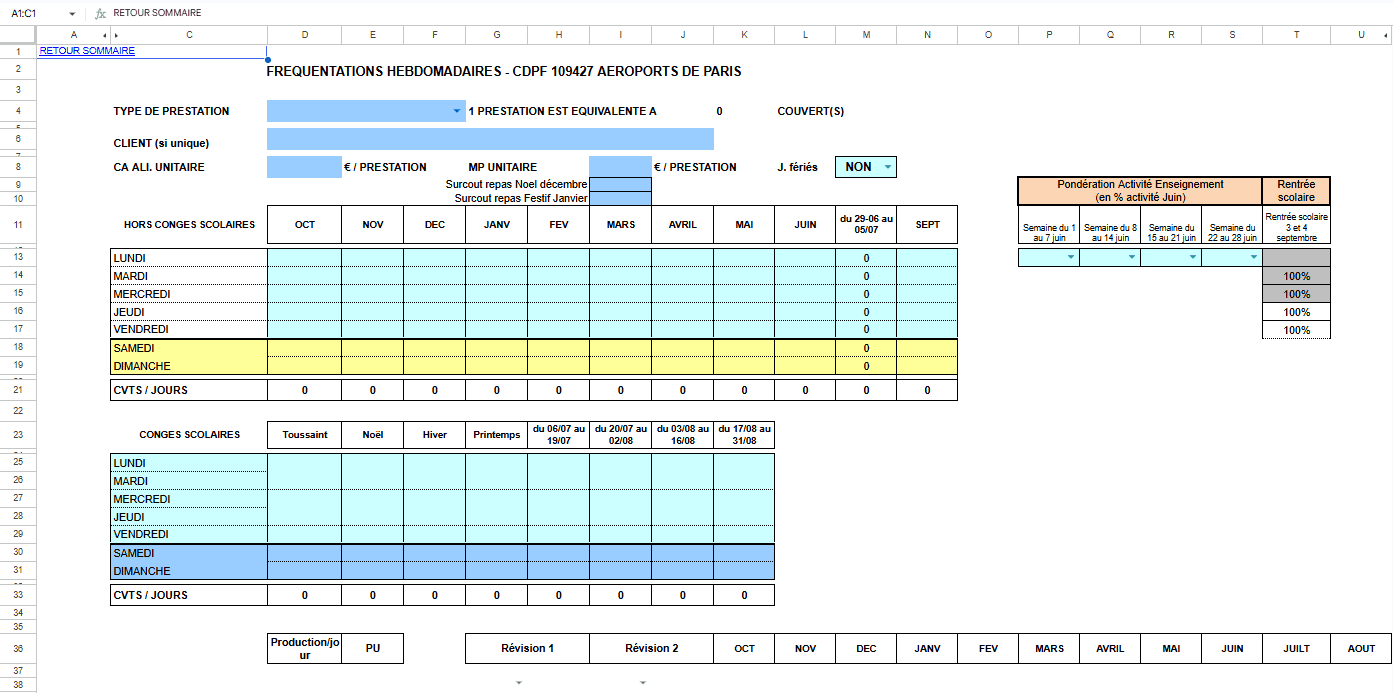
I complemented this research with interviews involving Site Managers, Operational Managers, Regional Directors, and support teams, alongside a company wide survey across Elior France.
The objective wasn't simply to redesign software. It was to understand how the business operates before proposing a better way of working.
Information Overload
Employees constantly switched between spreadsheets, shared files, and internal tools to complete routine tasks, creating unnecessary cognitive load throughout the day.
Fragmented Workflows
Budgeting and CDPF tracking depended on duplicated information, manual verification, and disconnected processes that slowed collaboration and increased errors.
One Platform Instead of Many
Employees consistently expressed a strong preference for one centralized platform that brings budgeting, planning, and operational workflows into a single experience.
Familiarity Drives Adoption
Users wanted the platform to reflect their existing terminology and business processes rather than introducing completely new workflows, making adoption easier across the organization.
Administrative Complexity
Interviews revealed that the growing volume of documents and operational tasks had become a major source of daily frustration, with some employees identifying administrative complexity as one of the reasons they chose to leave the company.
These insights directly shaped the product strategy and every major design decision.
Every project comes with trade offs, and this one was no exception.
The platform supports multiple departments, approval flows, and organizational hierarchies, requiring every design decision to satisfy diverse business needs.
Many users had relied on Excel for years, so I needed to modernize familiar workflows without increasing the learning curve.
Due to confidentiality, much of the product, research, and business logic cannot be shared publicly.
One of the biggest challenges wasn't designing individual screens. It was organizing a large ecosystem of operational processes into an information architecture that felt predictable and easy to navigate.
The platform combines budgeting, employee management, CDPF validation, reporting, operational planning, and configuration tools, all serving users with different responsibilities across the organization.
I mapped the product around users' operational responsibilities rather than business departments, ensuring that navigation reflected how employees actually work day to day. This made it easier for users to find relevant information while reducing unnecessary complexity.
The resulting architecture established a clear hierarchy between modules, workflows, and permissions, creating a scalable foundation for the rest of the platform.
One of the biggest challenges wasn't the interface. It was designing around Elior's organizational hierarchy.
The platform automatically filters information based on each user's responsibility perimeter. Regional Directors can access every CDPF within their region, while Site Managers only see the sites they manage. Markets such as Healthcare and Education are also filtered according to each user's assignment.
This permission based approach reduces visual clutter, simplifies navigation, and ensures users only interact with information relevant to their responsibilities.
The challenge wasn't making dashboards look modern. It was making complex operational data easier to understand and manage.
I transformed spreadsheet heavy workflows into structured interfaces while preserving familiar interactions such as editing prices, percentages, and financial values directly inside tables.
Rather than replacing what users already knew, I modernized their workflow with clearer hierarchy, better validation, and a significantly improved user experience.
Dashboard
A centralized overview of budgets, CDPF progress, and operational performance.

CDPF Validation
Role based approval workflows with clear ownership and validation tracking.

Activity Configuration
Configuring operational activities by selecting a CDPF and defining the activity setup required for budgeting and planning workflows.


C.A. & Direct Costs
Managing revenue, direct costs, and financial planning through structured, spreadsheet-inspired workflows designed for speed, accuracy, and easier budget management.


This project completely changed how I approach enterprise product design.
I learned that designing internal tools isn't about removing complexity. It's about understanding complex business operations well enough to organize them into experiences that feel intuitive.
It also reinforced the importance of investing heavily in research before exploring solutions. Spending time with users, studying operational processes, and understanding organizational structures made every design decision more informed.
If I were working on this project again, I would take a more proactive role in product strategy by suggesting additional features and workflow improvements beyond the original project scope.
I would also involve users earlier with interactive prototypes to validate complex workflows before implementation, allowing us to identify usability issues sooner.
Overall, this project strengthened my ability to translate complex business requirements into scalable products while balancing user needs, technical constraints, and business objectives.
Confidentiality
Due to confidentiality agreements, these are the only screens I'm permitted to share publicly.
If you'd like to learn more about the research process, product decisions, system architecture, or additional parts of the platform, I'd be happy to walk through the project during a portfolio review.

Designing an AI Workforce That Businesses Could Trust From Day One
How user research and Lean UX shaped an AI platform that hides technical complexity, builds trust, and helps businesses integrate AI into their daily operations with confidence.

Designing a Recovery Strategy for a Business in Crisis
A case study on helping one of Belgium's leading online printing companies recover after a high-impact rebrand by reducing friction, improving the purchasing journey, and creating measurable improvements in engagement and conversion.